How Recreational Football Develops Social Capital and Promotes Long-term Compliance for Women in Two Different Settings
L. Ottesen, R.S. Jeppesen, B. R. Krustrup
Dept Exercise and Sport Sciences, University of Copenhagen
Aim: This study examines the degree to which recreational women’s football organized in and outside clubs develops social capital and network to an extend that promotes long-term compliance.
Methods: Sixty women were studied using focus groups interviews, video observations and an email-based survey. Twenty-one subjects were organised in two football clubs and the remaining 38 were involved in a 16-week training intervention study with recreational football (n=21) or continuous jogging (n=17).
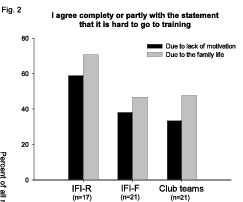
Results: In the intervention study/setting, the soccer players were motivated by the activity per se to a high degree, as well as having fun and being together in the group, the runners were much more motivated by the health benefits and wellbeing in general, which may influence how they surmount obstacles (Fig. 2) The football training differed from running training running, due to a greater degree of face-to-face contact, bodily contact, importance of knowing each other’s names and each other’s competences and the necessity of being able to cooperate, and that this contributes to a differentiated development of social capital among those participating in the two activities (Putnam 2003). In the club study/setting, two different clubs was selected which differed in age, the members at team A were 24,6 years old in average and team B were 43,7 years old. Team A, were much more competitive while team B played for fun. It was interesting to see that all the club players had participated in sports as a child, which confirms the observation that maintenance of physical activity is easier if one has been physically active during childhood. While the intervention football group only 52% and 71% for the intervention running group had been physically active as a child.
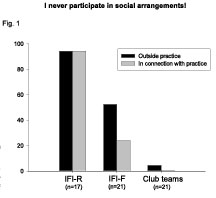
Conclusion: It can be concluded that recreational football contains several elements which improve the participants’ possibility to maintain their sports activity. Firstly, the motivation is based on a genuine interest in the activity, which makes it easier for the participant to deal with barriers to sports participation. And secondly, that the participants in football practice tell many activity-based ‘we-stories’, organise more social gatherings, accumulate more social capital and eventually obtain greater possibilities to construct networks with practical support, social support and a feeling of community. All football club players and 75% of the participants in the football intervention project have social gatherings in relation to training sessions and most of them also outside training, whereas 90% of the runners state that they never participate in social gatherings (Fig. 1).